Mizrahi Tefahot Bank Ltd. has carried company number 520000522 since 6 June 1923. The same legal entity, without interruption, for one hundred and three years. This timeline collects what is documented across that period, and only what is documented. Every date rests on a source read in full, and the items that could not be verified are set out explicitly at the end.
Quotations from Hebrew documents are given here in English translation; the Hebrew originals are held in the archive.
1923 to 1928: two banks, two movements
The Israeli Registrar of Companies records two separate incorporations. Bank HaMizrahi Ltd., company number 520000522, was incorporated on 6 June 1923, and its status to this day is active. Bank HaPoel HaMizrahi Ltd., company number 520001470, was incorporated on 19 May 1928, and its status today is liquidation by court order, meaning a compulsory winding-up rather than a voluntary one.
The report of the Israeli Parliamentary Commission of Inquiry into the Location and Restitution of Assets of Holocaust Victims sets out both foundings in a single passage:
"In 1923 Bank HaMizrahi Ltd. was founded by the World Centre of Mizrachi; Bank HaPoel HaMizrahi Ltd. was founded in 1928 by the Torah VaAvodah movement. In 1969 these two banks were merged and became United Mizrahi Bank Ltd."
Bank HaMizrahi raised its capital by selling shares at the movement's conventions in the United States, Europe and South Africa. That is the starting point for everything that follows, because those same shareholders are the subject of an examination conducted eighty years later.
1939 to 1940: the orders the bank did not comply with
Appendix 3 to the Commission of Inquiry report, titled "The examination at United Mizrahi Bank Ltd. - Kaspi & Kaspi, Certified Public Accountants", documents the conduct of the bank's management in the first two years of the war. The examiners found that in minutes and in correspondence with the management of Anglo-Palestine Bank, the management separately identified account holders abroad as depositors who:
"cannot claim their deposits, being abroad, or who are unlikely to claim them for other reasons"
And further, in the examiners' words: "The bank's management also emphasised, in some of the documents, that the place of residence of these depositors was occupied countries such as Russia and Poland."
Alongside this they found a document from mid-1940 in which Mr Pinkas of the bank's management describes the bank's true debt and notes expressly "of which, to the Jews of Germany, Poland and Belgium". By that date the enemy property orders were already in force: Germany from September 1939, Poland from January 1940, Belgium from June 1940. The examiners' finding is short:
"orders which the bank did not comply with"
In those same years public deposits at the bank fell by 88.6 per cent, from 380,625.510 Palestine pounds in 1938 to 43,336.759 in 1942, while other credit balances grew by 117.15 per cent.
1944 to 1945: Tefahot is born from entirely different money
This is the point at which the two halves of the present name separate completely. Tefahot was not founded by the Mizrachi movement and there is no documentation of any connection between them. It was founded by the Jewish Agency, out of Keren HaYesod funds.
The newspaper HaTzofe of 18 December 1944 gives the figure:
"50 thousand Palestine pounds were invested in the Tefahot company, a company for second mortgages for inter-urban housing"
Two months earlier, on 25 October 1944, Davar reported on the Zionist budget during the war years and listed within it the sum invested "in the Tefahot company for the provision of second mortgages for housing". Formal incorporation with the Registrar of Companies was recorded on 14 February 1945, company number 520014754. The gap between 1944 and 1945 is not a contradiction: 1944 is the decision and the substantive founding at the Jewish Agency, 1945 is the registration.
From there Tefahot moved on a governmental track. In 1949 it became a subsidiary of Amidar and was known as "the Amidar bank". On 19 February 1960 Al HaMishmar reported "a considerable development in the operations of the Amidar bank - Tefahot". And on 18 December 1961, in the same paper:
"The Tefahot company has submitted an application to the Bank of Israel to become a mortgage bank - so stated the spokesman of the Ministerial Committee for Economic Affairs. Tefahot, which is a subsidiary of Amidar..."
1974: the bank erases its own history
In documentary terms this is the single most consequential event in the entire timeline. When the bank moved its accounts onto computer, the true opening dates were erased. In the examiners' words:
"In the computerisation process the entire history of the account was lost, since on entry into the computer each account received the date of entry as its opening date, and the balance on the day of computerisation is the starting point for the management of the account on the computer. In other words: past transactions were not entered into the computer and the bank lost information of great importance to this inquiry."
The examiners spoke with the man who served as the bank's comptroller from 1971 and was a member of the original computerisation team. Two further details emerged from him: the bank prepared no summary report at the end of the computerisation operation, and the discrepancies found between manual and computerised clearing "were considered immaterial and were therefore recorded in the bank's profit and loss statement".
1975: "liable to obscure the real severity"
On 31 July 1975 the front page of Davar carried a report of a demand in the Knesset Finance Committee to re-examine the conduct of Bank Tefahot. Member of Knesset Zalman Shoval demanded a more thorough examination, and his reason, in the words of the report, was that:
"the reports submitted so far are liable to obscure the real severity arising from the manner of Bank Tefahot's activity"
What came of that demand was not located. The protocols of the Eighth Knesset are not accessible in the open databases, and no decision, indictment or sanction arising from the affair was found.
1980: by a single million
On 9 March 1978 Davar published the ownership breakdown of Bank Tefahot ahead of privatisation: the Government held about 52 per cent of control, and Israel Investors 16 per cent. The plan was to sell the Government's block to a merged vehicle of Clal, Israel Investors and the Israel Corporation, and it stalled for a technical reason: "Israel Investors is an American company and must act in accordance with the merger laws of the United States."
A year earlier, on 12 July 1977, Maariv reported that the Ministry of Finance had decided in principle to sell. Clal and Israel Investors then argued that under their agreement they held a right of first refusal over the Government's shares, and an examination by the Government Companies Authority at the Ministry of Finance determined that the claim was not correct.
On 19 February 1980, under the headline "By a single million: how Bank HaMizrahi won Tefahot", Maariv described a last-minute reversal. One line in the article explains the headline:
"Until last Friday, the highest bid for the Government's shares in Tefahot was that of Bank Leumi - 700 million Israeli lira"
Bank Leumi bid 700 million lira. Bank HaMizrahi bid 701 million and won. On 30 March 1980 Maariv reported the completion of the transaction, and the body of the article states exactly what was bought: "a cheque in the sum of 701 million lira in exchange for the shares... 52 per cent of control in Bank Tefahot". Beside the article ran a photograph captioned "Aharon Meir, CEO of Bank HaMizrahi".
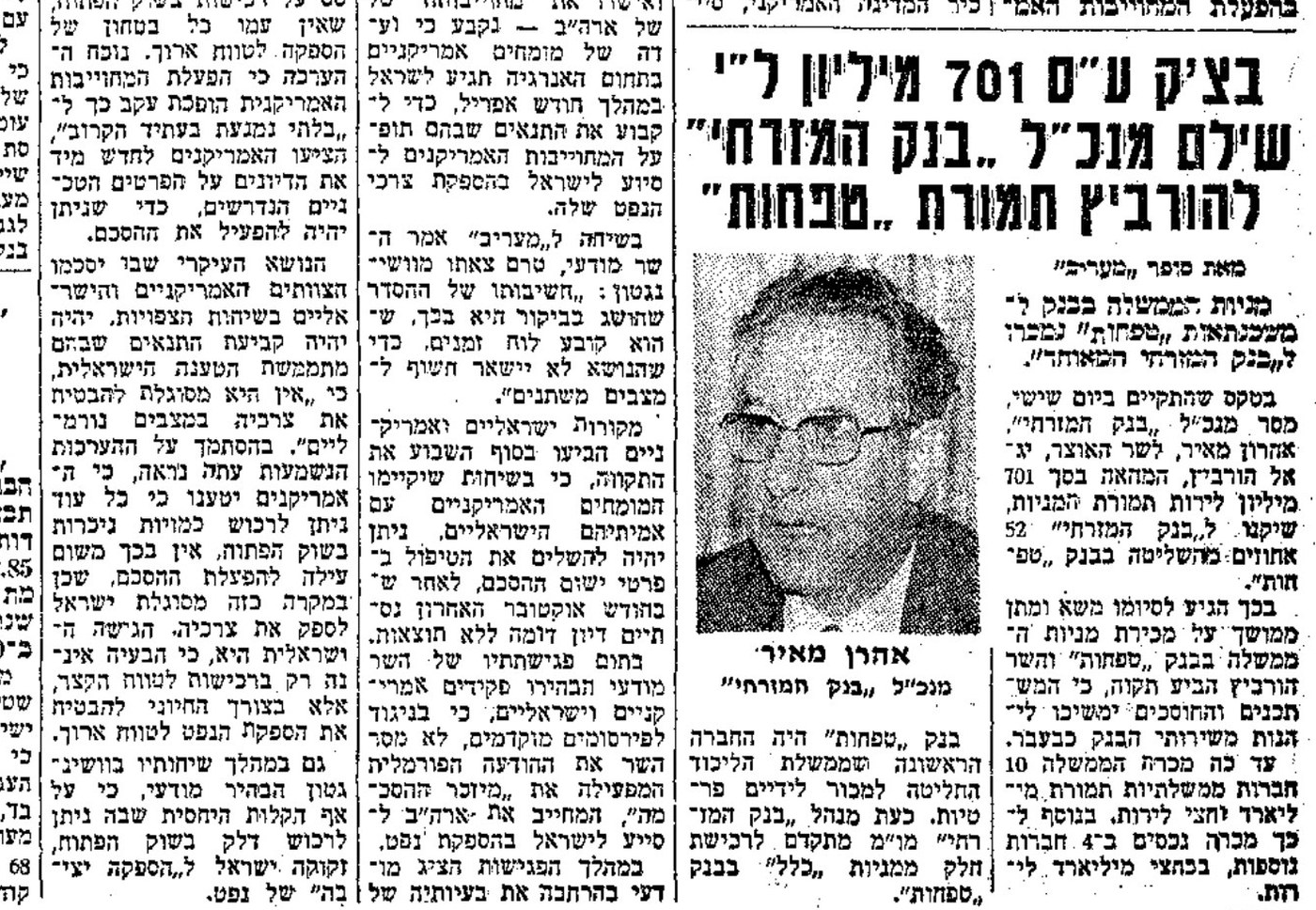
Six years later, in April 1986, the Bejski Commission held that the heads of the banks, Meir among them, could not continue in their roles, and he resigned that month. He was subsequently convicted in the District Court, and his appeal was heard by the Supreme Court in CrimA 2910/94 Yafet and others v. State of Israel. The convictions that stood on appeal: obtaining a thing by fraud in aggravated circumstances, and false entry in corporate documents. His sentence: two years suspended imprisonment and a fine of ILS 600,000, with no actual imprisonment. The conviction concerns the regulation of bank shares and not the acquisition of Tefahot.
2005: Tefahot is struck off, 1923 survives
The Bank of Israel's Israel Banking System review for 2005 gives the precise chronology of the merger. Bank Tefahot operated as a separate bank until 31 December 2004. In January 2005 the merger took effect. In April 2005 Tefahot's banking licence was revoked. In November 2005 the name of United Mizrahi Bank Ltd. was changed to Mizrahi Tefahot Bank Ltd.
The corporate outcome is sharp: the surviving company is the one from 1923. Tefahot, the 1945 entity, is recorded today at the Registrar of Companies as dissolved by merger. In legal terms Mizrahi Tefahot is Bank HaMizrahi; Tefahot was absorbed into it.
In parallel, between 2000 and 2005, the Parliamentary Commission of Inquiry into the Location and Restitution of Assets of Holocaust Victims was at work. It selected five banks it defined as relevant to the period: Leumi, Hapoalim, Discount, Mercantile Discount and United Mizrahi. Bank Tefahot was not examined and does not appear in any of the commission's protocols. In the final report, across 209,605 characters, the word Tefahot appears zero times.
The findings of the examination at United Mizrahi Bank: 8,082 shareholders recorded in the bank's registers from the day of its founding, of whom 309 held addresses in Europe or no known address; a further 786 at Bank HaPoel HaMizrahi. And in a sentence of its own: "We discovered 136 shareholders who had paid for rights to shares that had not yet been allotted to them." The bank's liability not yet returned, revalued to 30 September 2004, stood at ILS 1,774,688, against ILS 81,901 at Bank Hapoalim.
The registers themselves survived by accident. The examiners record that the bank "greatly reduced its storage space in the branches", that in many cases "old documents were destroyed, apparently to free space in the storeroom for newer documents", and that there was no retention procedure. And then:
"Notwithstanding the above, one branch kept the shareholder registers; when the branch manager learned of the examination, he approached our office and transferred the registers into our hands."
As to the dormant accounts, the only documented initiative ran in the opposite direction: "The bank apparently paid no interest on accounts without movement, and on the contrary charged them fees", until accounts whose balance had been in credit became debit accounts, and "several years later these accounts were closed on the initiative of the branch management". The final report adds: "no report by the bank on the closure of inactive accounts was found".
2012 to 2026: the pattern that recurs
Over the past decade and a half, five enforcement decisions have accumulated against the corporation, totalling ILS 11,472,588. These are administrative sanctions and civil fines, not criminal convictions.
- 20 January 2004: the sanctions committee for banking corporations determines that Bank HaMizrahi breached anti-money-laundering provisions, but confines itself to a written warning and imposes no sanction, given the proximity of the breaches to the law coming into force.
- 19 September 2012: a financial sanction of ILS 3,800,000, based on an audit report covering operations in 2007 to 2010. Among the breaches: maintaining accounts for lawyers without a beneficiary declaration, failure to report unusual transactions, and reports transmitted with considerable delay to the Money Laundering Prohibition Authority.
- 6 February 2023: a financial sanction of ILS 700,000 for breach of section 25 of Proper Conduct of Banking Business Directive 450, concerning debt collection. The breach: failure to report to the Execution Office, within seven days, receipts received from customers on account of a debt outside the office, together with reports bearing an incorrect value date and submitted late. The original intention was ILS 1,000,000, reduced by 30 per cent after a hearing. The Bank of Israel announcement stated that the deficiencies "emerged from a proactive audit".
- 10 June 2024: a civil fine of ILS 172,588 for holding means of control in a significant real corporation at a rate exceeding that permitted under section 24a of the Banking (Licensing) Law.
- 25 March 2026: a financial sanction of ILS 6,800,000 for breach of four provisions of the Prohibition on Money Laundering Order, including 12 cases of failure to report unusual transactions and 35 cases in which business accounts were classified as private in know-your-customer questionnaires. The committee held that this was "a serious failure in the classification of the transactions", that the bank "was negligent in the exercise of its discretion", and that it "did not properly document, in real time, the discretion underlying the failure to report".
Within the same period the bank also entered into a deferred prosecution agreement with the United States Department of Justice, on 12 March 2019, in the sum of $195 million. Such an agreement is not a conviction, but the admission of facts forms part of it, and among other things the bank admitted holding customers' bank mail in Israel and Switzerland instead of sending it to them.
What links the periods is not the amount. $195 million, ILS 6.8 million and ILS 1,774,688 are entirely different orders of magnitude. What recurs is the documentation: in 1974 the opening dates were erased; in the American matter customers' mail was held rather than sent; in 2023 it was found that reports to the Execution Office were not delivered on time and carried incorrect value dates; and in 2026 that the bank did not document its discretion in real time. In every instance where documentation was needed in order to examine the bank, the documentation was not there.
What has not been established
Precision requires stating what is missing as well. The following items were examined and not verified, and must not be presented as fact:
- The names of Tefahot's founders and founding shareholders, and the number of shares at founding. The capital, 50 thousand Palestine pounds, is documented.
- What came of the 1975 loans affair at Bank Tefahot. The demand for an examination is documented; the outcome was not located.
- The Bejski Commission report itself, and its specific findings on Bank HaMizrahi as an institution. The report is not available online.
- What became of the 136 shareholders who paid and received no share, and whether any indemnity was ever paid. The examiners wrote that the dividends and bonus shares "cannot be reconstructed", and therefore that "the question of indemnifying the shareholders must be considered by another route".
- Whether Tefahot's own shares were included in the bank shares arrangement. Tefahot does not appear in the list of regulated banks.
- Any connection to the Haavara Agreement was examined and ruled out. A 115-page monograph on the agreement was searched in full, and Bank HaMizrahi does not appear in it even once. The banks it names are Paltreu, the Reichsbank, Warburg, Anglo-Palestine Bank, Hanotea, Wassermann and the Bank der Tempelgesellschaft.
Related sources
This investigation spans three separate archives, each holding a different class of document.
- Mizrahi Tefahot, company 520000522 (Hebrew) — the company registration, the chain of companies around it, and what became of the movement's economic institutions.
- Special Investigation: Mizrahi Tefahot Bank, three files and one pattern — at White Collar Crime Israel: the Holocaust victims' shares, the $195 million U.S. settlement, and the Bank of Israel sanction of March 2026.
- mizrahi-tfahot-case.com — the enforcement file and the database of legal proceedings against the bank and its subsidiaries.
Sources: Registrar of Companies, data.gov.il. Report of the Parliamentary Commission of Inquiry into the Location and Restitution of Assets of Holocaust Victims and its Appendix 3. Bank of Israel, Israel Banking System review 2005. Banking Supervision Department decisions of 2012, 2023, 2024 and 2026. U.S. Department of Justice press release 19-215. CrimA 2910/94 Yafet and others v. State of Israel. Contemporaneous Hebrew press from the Historical Jewish Press website, www.JPRESS.org.il, founded by the National Library of Israel and Tel Aviv University: Davar 25.10.1944, HaTzofe 18.12.1944, Al HaMishmar 19.2.1960, Al HaMishmar 18.12.1961, Davar 31.7.1975, Maariv 12.7.1977, Davar 9.3.1978, Maariv 19.2.1980, Maariv 30.3.1980.