Mizrahi Tefahot Bank carries the name of a movement: "Mizrahi", an acronym of the Hebrew words for "spiritual center". Yet one of its founding shareholders, the Berlin artist Hermann Struck, co-signed a foreword seven years before the bank was registered, in a book dedicated to the German general Erich Ludendorff. These are the words, from the book itself.
The quotes from the book
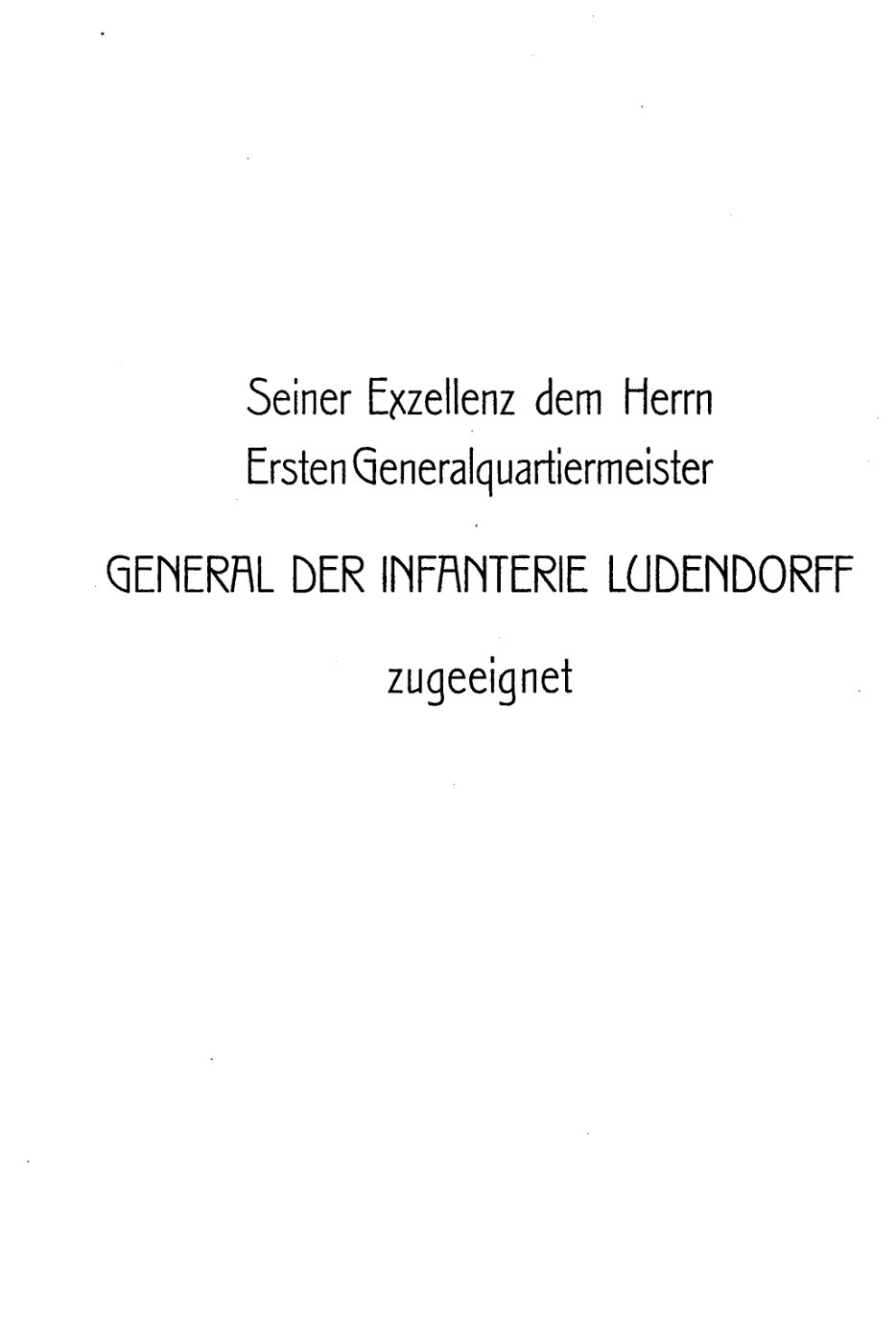
"Seiner Exzellenz dem Herrn Ersten Generalquartiermeister General der Infanterie Ludendorff zugeeignet.""Dedicated to His Excellency the First Quartermaster General, General of the Infantry Ludendorff."
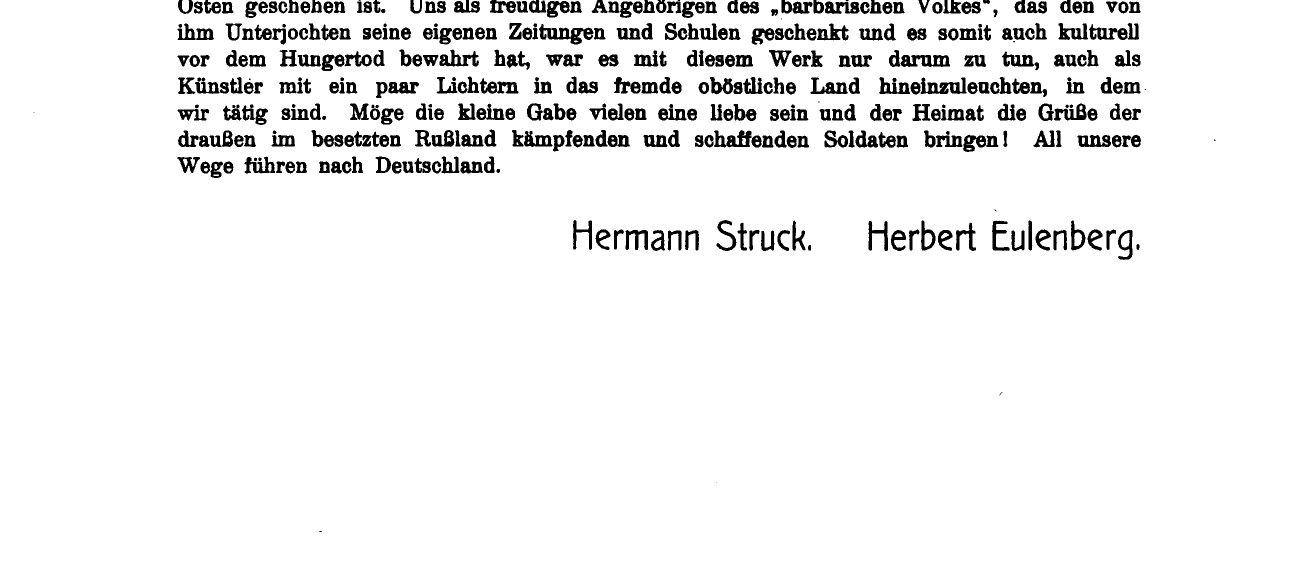
"Uns als freudigen Angehörigen des ‚barbarischen Volkes', das den von ihm Unterjochten seine eigenen Zeitungen und Schulen geschenkt und es somit auch kulturell vor dem Hungertod bewahrt hat...""To us, as joyful members of the 'barbarian people', which gave those it subjugated their own newspapers and schools and so saved them from cultural starvation as well..."
"Möge die kleine Gabe vielen eine liebe sein und der Heimat die Grüße der draußen im besetzten Rußland kämpfenden und schaffenden Soldaten bringen! All unsere Wege führen nach Deutschland.""May this small gift be dear to many and bring the homeland the greetings of the soldiers fighting and creating out there in occupied Russia! All our roads lead to Germany."
The foreword is signed jointly by both authors: "Hermann Struck. Herbert Eulenberg." The quotes are attributed to both.
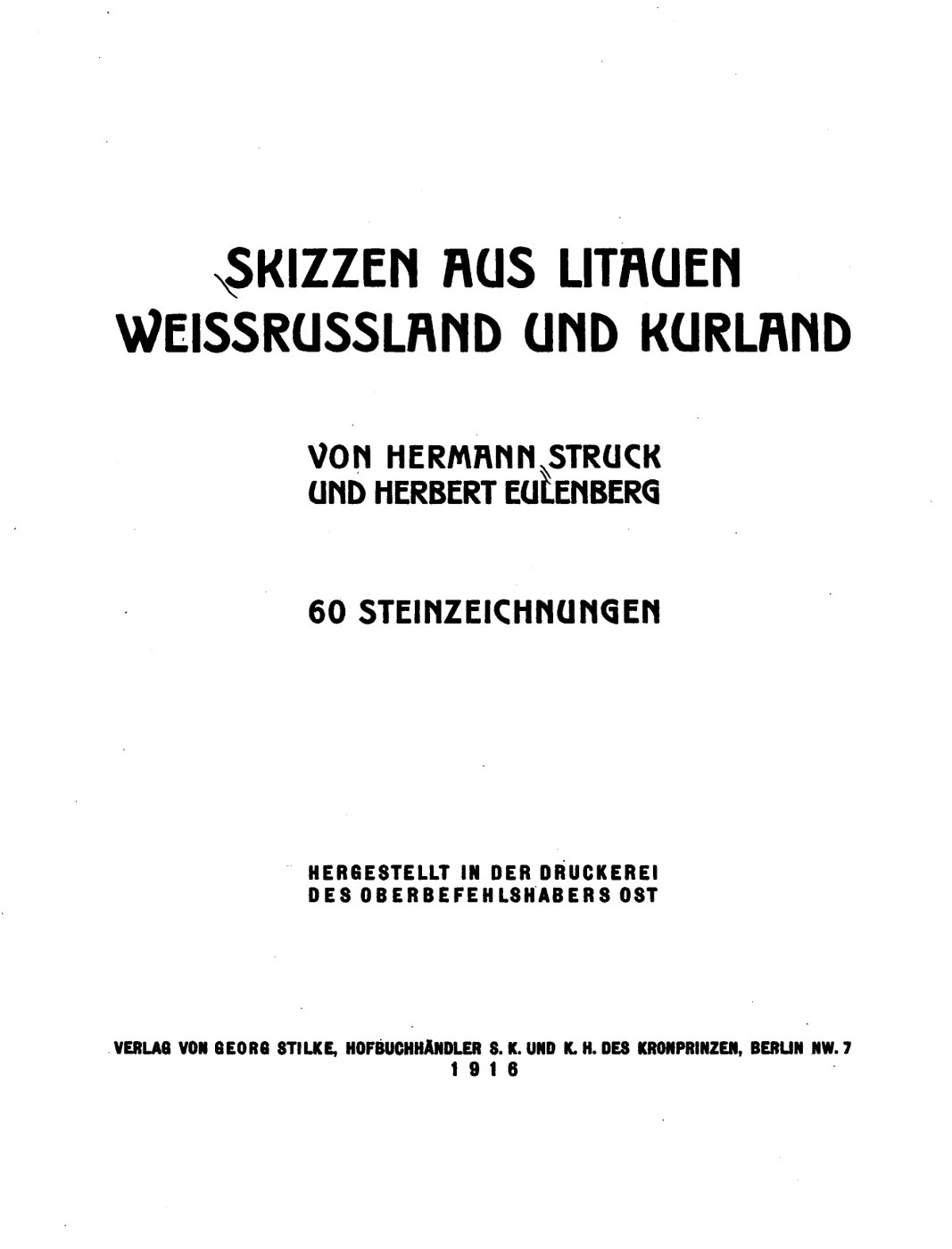
The 1916 book
The book is "Skizzen aus Litauen, Weissrussland und Kurland", sketches from Lithuania, Belarus and Courland: sixty lithographs by Struck with text by the poet Herbert Eulenberg. The title page states it was printed "in the printing house of the Supreme Commander East", Ober Ost, the German military command over the territories taken from Russia. Ludendorff was its chief of staff from November 1914 to August 1916.
In his diary Struck recorded a conversation with Ludendorff on July 1, 1916, and a lecture before Ludendorff and Hindenburg on July 15, according to research by the Haifa Center for German and European Studies.
Who was Hermann Struck
Hermann (Chaim Aharon) Struck was born in Berlin in 1876. On July 23, 1915 he volunteered for the Kaiser's army, served on the Eastern Front, became an officer and received the Iron Cross. From 1917 he handled Jewish affairs in the occupied territories. In December 1922 he settled in Haifa.
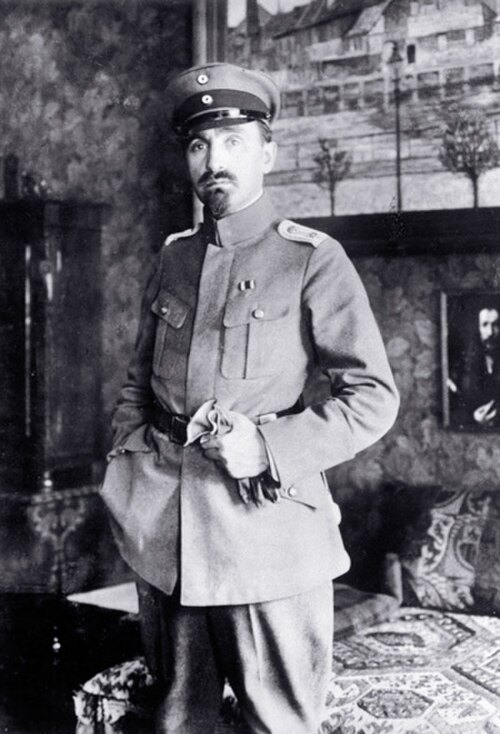
Why did he leave Berlin? His student Meir Ben-Uri wrote that the reason was the Mizrachi movement, "with which he identified, in which he was active and even one of its leaders". No statement by Struck himself on the reason has been found.
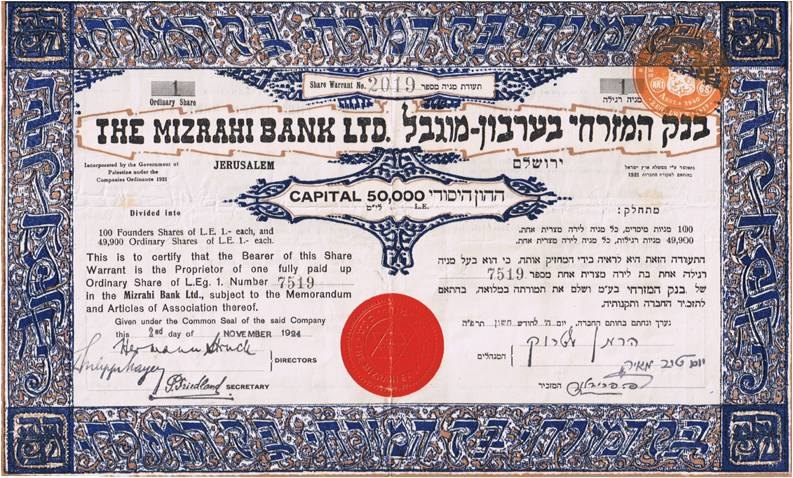
According to the newspaper Doar Hayom, as cited by Wikipedia, the founder shares of Bank Mizrahi were allotted to Rabbi Yehuda Leib Fishman (Maimon), Hermann Struck and Professor Chaim Pick. Struck signed the bank's 1924 share certificate as a director.
Where the name comes from
"Mizrahi" is an acronym of "merkaz ruhani", spiritual center. Rabbi Samuel Mohilever used the phrase in 1893, and Rabbi Yitzchak Yaakov Reines founded the Mizrachi movement in Vilna in 1902. The bank took the name of the movement that created it. The name does not refer to "the East" or to Mizrahi Jews.
1923: the bank is registered, Ludendorff marches with Hitler
The Mizrahi Bank Ltd. was registered on June 6, 1923 as company number 520000522, still the number of Mizrahi Tefahot Bank today. On September 2, 1923 Hitler and Ludendorff took part in the "German Day" rally in Nuremberg. On November 9, 1923 Ludendorff marched beside Adolf Hitler in the Munich putsch. At the trial that ended on April 1, 1924 Hitler was sentenced and Ludendorff acquitted.
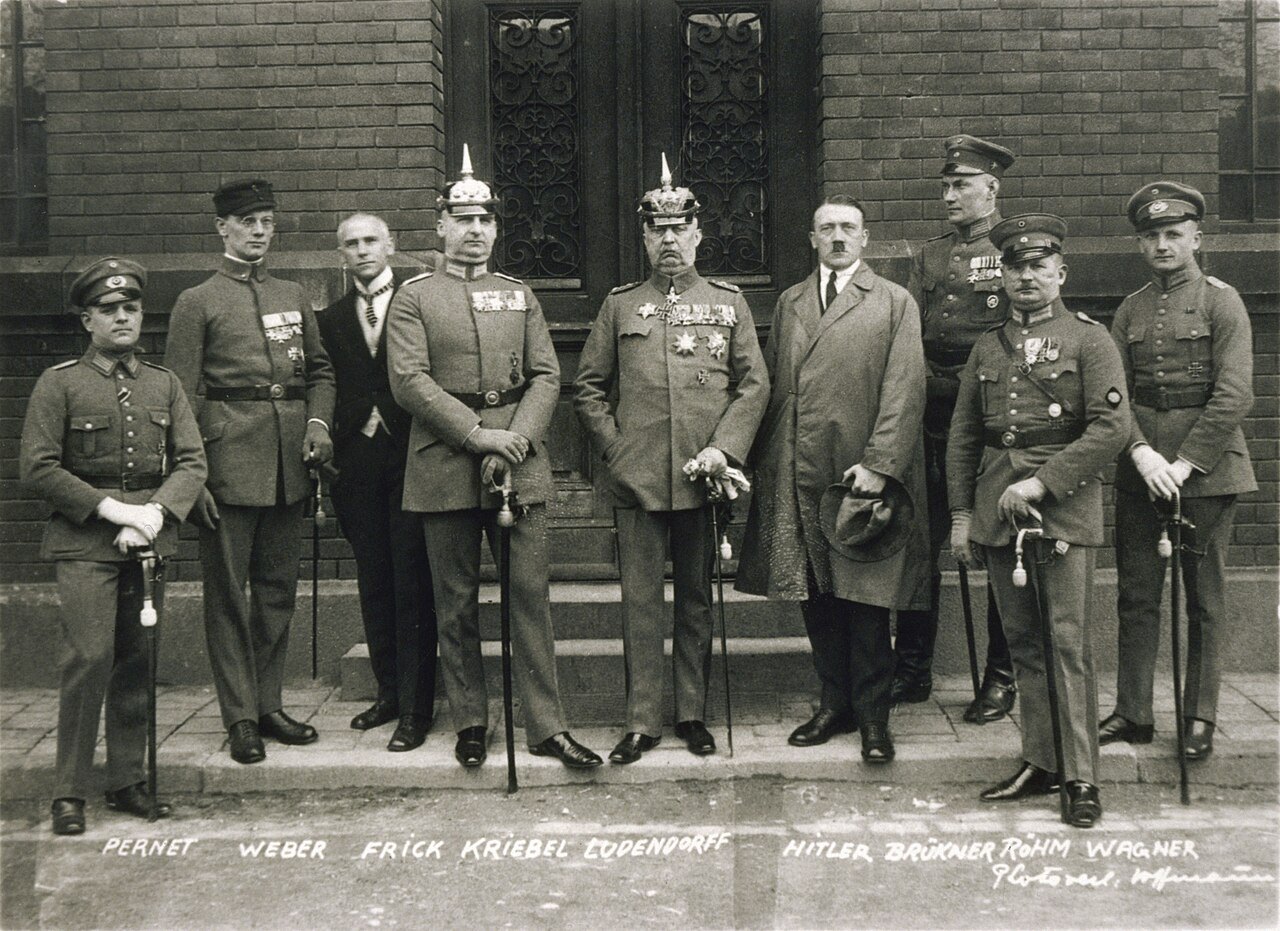
There is no source for any link between Struck and Hitler. What is documented: the man to whom Struck dedicated his book in 1916 marched beside Hitler in Munich five months after Bank Mizrahi was registered.
1924: the money of European Jews
Hator, the Mizrachi movement's newspaper, reported on April 4, 1924 two meetings at the World Mizrachi office in Jerusalem about the bank, attended by "Prof. Chaim Pick and Mr. Hermann Struck and Mizrachi members from Germany, Poland and Belgium now staying in Palestine". According to the report, "some of the guests signed for a good number of the bank's shares and paid for them in full".
In September 1924 the World Mizrachi Council met in Berlin. According to Hator of October 12, 1924, "the council was opened in the hall of the Jewish community by Mr. Hermann Struck". The resolution: "the council imposes a duty on all national federations to act energetically in propaganda for the distribution of Mizrahi Bank shares". Dr. Federbusch of Lviv told the council that "in Poland too a good number of the bank's shares can be distributed".
Hator of December 10, 1924 published the promise: the bank "will greatly help the establishment of the Mizrachi members coming to settle in the Land of Israel". The founding capital: "fifty thousand Egyptian pounds, divided into one hundred founder shares and forty-nine thousand ordinary shares".
1939 to 1940: the same three countries
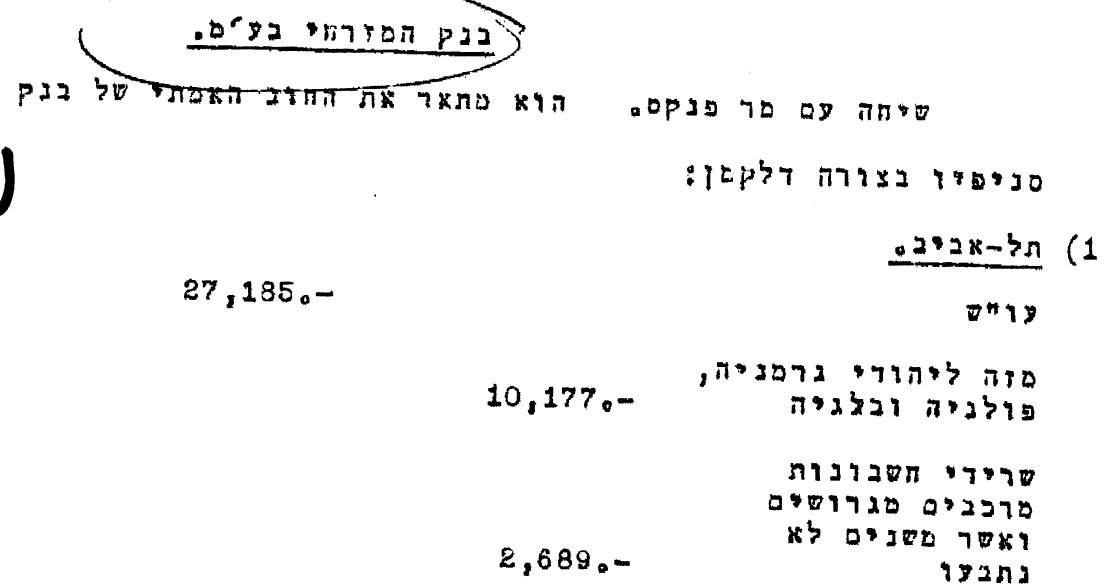
On September 21, 1939 the bank's management decided on a loan from the Anglo-Palestine Bank with "a general charge on all its assets". On October 29, 1939 the bank reported to its creditor 28,000 Palestine pounds of depositors and wrote next to them "no claimants": "the depositors cannot claim their deposits at present, being abroad". Protocol 175 of August 16, 1940 lists "sums whose owners are abroad, deceased, or accounts without movement".
A mid-1940 document of the Tel Aviv branch records "of which to the Jews of Germany, Poland and Belgium", 10,177 pounds. These are the same three countries whose Mizrachi members bought the bank's shares in 1924.
2001: "no material at all"
When the Knesset inquiry's auditors arrived, they were told the bank had "no material at all" relevant to the audit. A retired senior employee told them "the bank never had customers from Europe". According to the auditors, until 1979 "every branch destroyed old material to make room for new", and in the 1974 computerization the historical data were "lost beyond recovery".
In the shareholder registers the auditors found 309 shareholders "whose address is in Europe or unknown". 136 shareholders paid for shares that were never allotted to them, and the money was "closed in central accounts and apparently not returned". In 2012 Mizrahi Tefahot Bank paid 9.5 million shekels "without admitting any liability".
A name is a promise
American readers know the idea from the Swiss banks of the 1990s: a bank that took deposits from Jews before the war and later said it could find no owners. The question here is the same, and so is the principle. A bank sells trust under its name. In 1924 this bank asked Jews in Europe for their money with a promise. The documents of 1939 and 1940 show what it wrote about them when they could no longer come.
What was not found
No source shows the bank was founded by a German officer alone: it was founded by the Mizrachi movement, and Struck was one of three founding shareholders. No source shows the entire founding capital came from German Jews. No source shows any meeting or link between Struck and Hitler. New findings will be added with a date.
Further reading
Sources: [1] Hermann Struck, Herbert Eulenberg, Skizzen aus Litauen, Weissrussland und Kurland, Berlin 1916, archive.org/details/skizzenauslitaue00stru. [2] Hator, 4.4.1924, 12.10.1924, 31.10.1924, 10.12.1924, National Library of Israel newspaper collection. [3] Appendix 3 to the report of the Knesset Commission of Inquiry, m.knesset.gov.il/Activity/committees/documents/shoa-app_3.pdf. [4] Meir Ben-Uri, "Talmid al Rabo", 2005, p. 28. [5] HCGES, University of Haifa, Portraits of the Eastern Front. [6] GHDI, image 4283. [7] Mizrahi Tefahot Bank annual report 2012.
AI assisted in locating sources and drafting. Every quote was checked against the original document. Nothing here is legal advice.