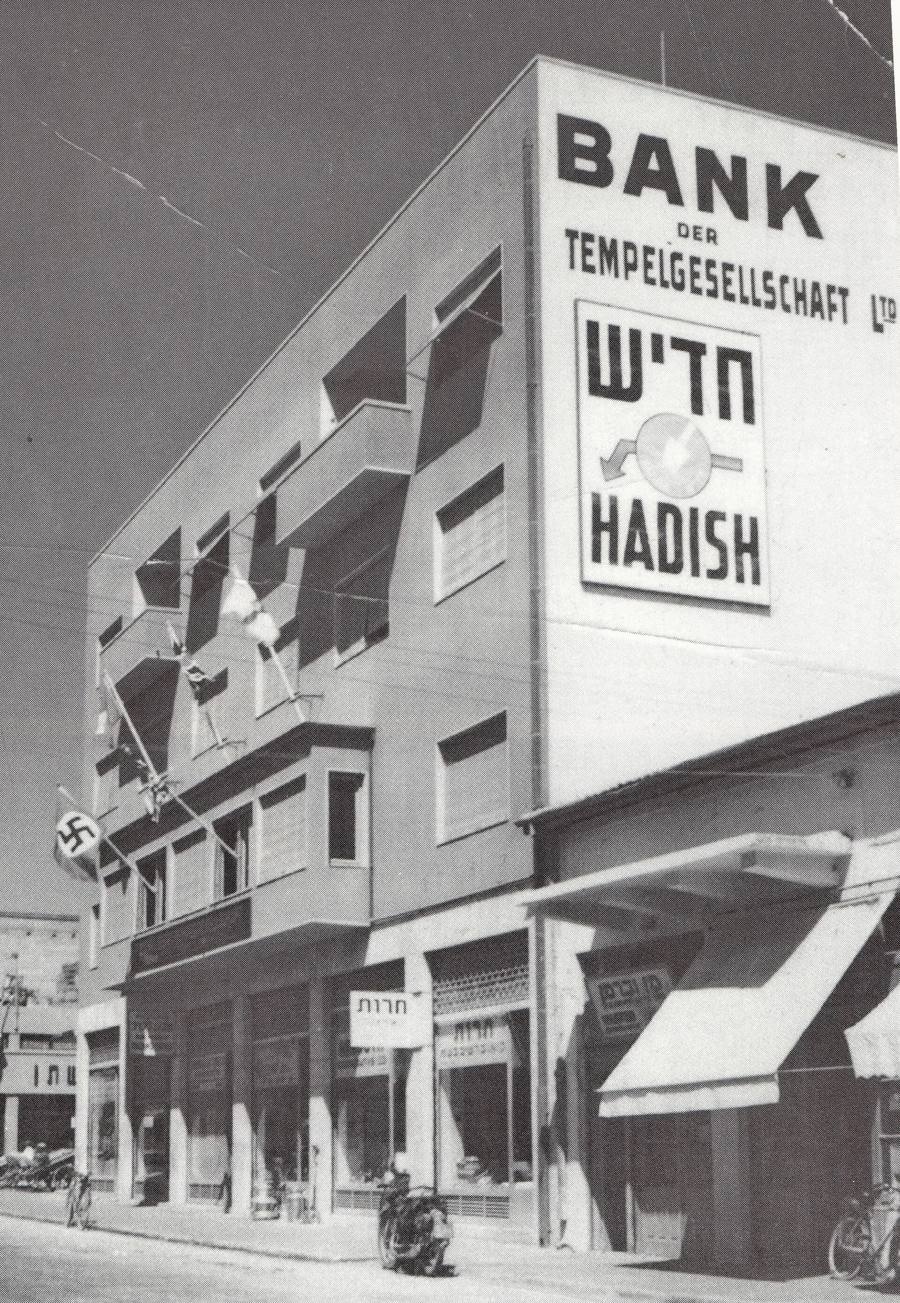
In 1923 two banks belonging to religious movements opened in Palestine. One, Bank HaMizrahi, is today Mizrahi Tefahot Bank, Israel's third largest bank. The other, the Bank of the Temple Society, was a German bank whose building in Jaffa flew swastika flags in the 1930s. In the records of the Knesset's Parliamentary Commission of Inquiry, both banks appear inside the same mechanism: the Haavara Transfer Agreement with Nazi Germany.
The Templer bank held the transfer accounts at the Reichsbank. Bank HaMizrahi, according to the Commission's findings, received money in documented cases directly from the German arm of the agreement. In September 1939 the same British order applied to both banks. The German bank was liquidated. Bank HaMizrahi carried on and, according to the Commission's accountants, did not comply with the orders.
American readers know a version of this question from the 1990s, when Swiss banks were asked what became of the deposits of Jews who never came back. The principle at stake is the same one every bank customer relies on: a fiduciary duty does not lapse because the person owed it can no longer ask.
1923: two banks, two movements
Bank HaMizrahi Ltd. was registered with the Israeli Registrar of Companies on 6 June 1923 under company number 520000522, which is still the number of Mizrahi Tefahot Bank today. It was founded by the World Centre of the Mizrachi movement, and its capital was raised by selling shares at movement conventions in the United States, Europe and South Africa.
The Temple Society (Tempelgesellschaft) is a Protestant Christian movement from Württemberg. It has nothing to do with the medieval Knights Templar. Its members settled in Palestine from 1868 and built the German colonies in Haifa, Jaffa, Sarona (today the Kirya in Tel Aviv), Jerusalem and Wilhelma. According to the German Federal Archives, the Society founded the Bank der Tempelgesellschaft in 1923, headquartered in Jaffa with branches in Haifa and Jerusalem; besides Jewish and Arab staff it employed more than forty Germans. [1] Other sources give 1924 or 1925 as the founding year.
The flag on the building
In the 1930s the Nazi Party took root in the Templer community. Historian Ralf Balke, who has researched the party's Palestine branch, describes how individuals contacted the party's foreign organisation from 1931, and how an architect in Haifa wrote asking how to join. After Hitler came to power in 1933, party membership jumped to about 17 percent of adults, against an average of 5 percent among Germans abroad elsewhere. Membership, he says, was seen as "a kind of insurance". [2]
During the Arab revolt of 1936 to 1939, the local party leader Cornelius Schwarz ordered every German in Palestine to wear a swastika badge so as not to be mistaken for a Jew or a Briton. Balke also tells of the milk truck that ran between the German colony of Wilhelma and Jerusalem: it sometimes carried Jewish passengers, who had to wave a swastika flag as it passed through Arab areas. [2]
The 1936 photograph shows that world. Swastika flags hang from the Templer bank in Jaffa, and directly below them, in the same building, are signs in Hebrew. Germans, Jews and Arabs shared the same street and the same bank.
The Transfer Agreement: an account in the Templers' name at the Reichsbank
On 25 August 1933 the Reich Ministry of Economics and the Anglo-Palestine Bank signed the Haavara Transfer Agreement. Jews emigrating from Germany deposited their money there; it paid for German goods exported to Palestine, and the proceeds were paid out to them on arrival.
Appendix 1 to the Commission's report, the examination at Bank Leumi, sets out on page 42 where the money went: into two special accounts at the Reichsbank, the central bank of Nazi Germany, named Bank der Tempelgesellschaft, Sonderconto I and Sonderconto II. In the appendix's words: "the Templer bank will hold the receipts in the two special accounts at the Reichsbank at the disposal of the Anglo-Palestine Bank." [3] The money of German Jews passed through accounts bearing the name of the German community's bank in Palestine, the same community whose building flew the swastika.
"Directly from PALTRO to other banks: Bank HaMizrahi"
Appendix 2 to the Commission's report, the examination at Bank Hapoalim carried out by the accounting firm Herzfeld-Blatberg, reviews on pages 11 and 12 the archive of the Haavara company and the archive of the German Department of the Jewish Agency. The examiners wrote:
"Registration and the first transfers of money were made through the company's German branch, PALTRO, and from it to the Templer bank and to the Anglo-Palestine Bank. Import payments to Germany were also made through the Templer bank."
And further:
"However, we found cases in which money was transferred not through the Templer bank and the Anglo-Palestine Bank but directly from PALTRO to other banks: Bank HaMizrahi, Barclays Bank, Bank Japhet and Bank Hapoalim." [4]
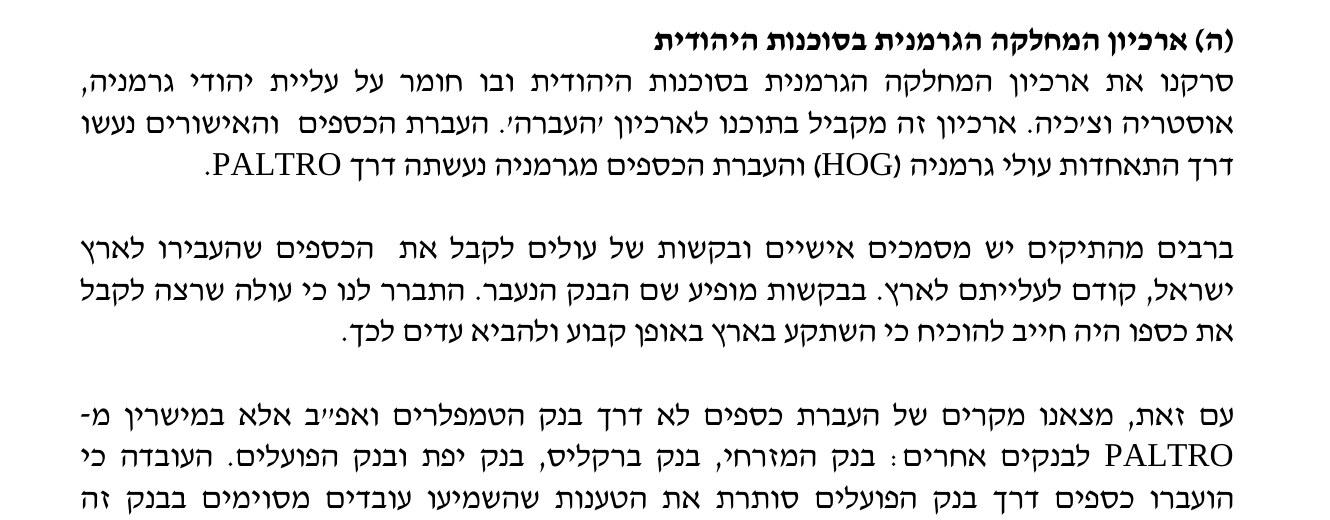
PALTRO, spelled Paltreu in other sources, was the Palästina-Treuhandstelle founded in Berlin on 17 August 1933 to run the transfer on the German side. [3] The usual route ran through the Templer bank and the Anglo-Palestine Bank. In the cases the Commission recorded, the money bypassed both and went straight to Bank HaMizrahi.
Precision matters about what the document does not say. The examiners did not give the number of cases, the amounts or the names of those who transferred. The document records no direct transfer between the Templer bank and Bank HaMizrahi, and it does not claim Bank HaMizrahi was a party to the agreement. It establishes one thing: Bank HaMizrahi received money directly from the German arm of the transfer. The standard monograph on the agreement (Feilchenfeld, Michaelis and Pinner, Leo Baeck Institute, 1972) never mentions Bank HaMizrahi, because it describes the agreement's institutions, while the Knesset finding concerns individual transfers traced in the files.
Mizrahi Bank shares in the German Jewish press, 1935
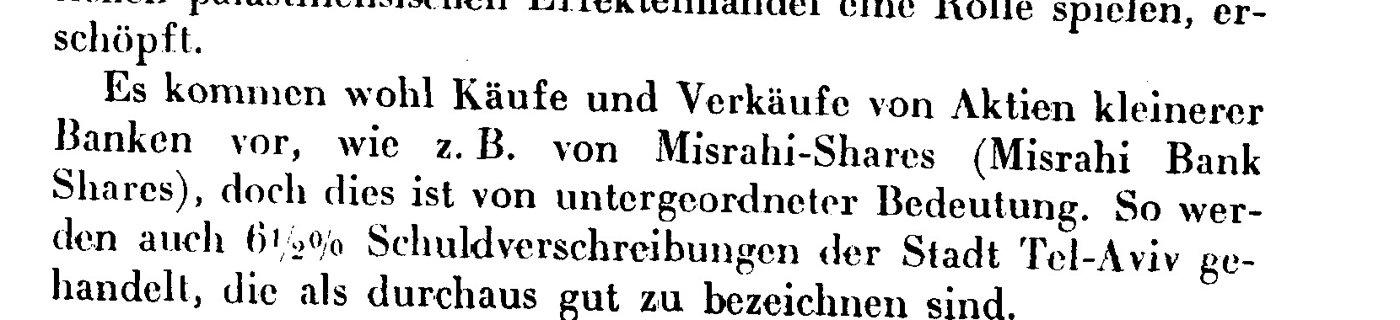
Bank HaMizrahi was known to Jewish readers in Germany at the time. In December 1935 the journal Palästina-Nachrichten reviewed securities trading in Tel Aviv and noted purchases and sales of shares of smaller banks, "such as Misrahi-Shares (Misrahi Bank Shares)", though "of secondary importance". [5] Mizrahi Bank stock was traded, and German-speaking investors knew it.
September 1939: one order, two fates
When the war broke out, the British Custodian of Enemy Property issued an order requiring the funds of enemy nationals to be reported and handed over. It took effect for Germany in September 1939, for Poland in January 1940 and for Belgium in June 1940.
The Templer bank was placed in liquidation from 12 September 1939 by the Official Receiver of the Government of Palestine; the liquidation ran until February 1948. [1] Bank HaMizrahi carried on. Appendix 3 to the Commission's report, the examination at United Mizrahi Bank by the firm Kaspi & Kaspi, quotes management's own letters from those months. A letter of 29 October 1939 notes beside deposits of 28,000 Palestine pounds that "the depositors cannot claim their deposits, being abroad, or are unlikely to claim them for other reasons". A mid-1940 document by Mr Pinkas of the bank's management, describing the bank's true debt, says expressly: "of which, to the Jews of Germany, Poland and Belgium". The examiners found these were "orders which the bank did not comply with". [6]
A draft management letter from the same period contains a struck-out line: "the German tyrant is preparing acts of aggression against Poland". The examiners say this confirms that "the bank's management knew what was happening in Europe". [6]
Credit against the depositors
Why did Bank HaMizrahi report to the Anglo-Palestine Bank on funds that "will not be claimed"? The Commission's accountants gave their view plainly:
"In our opinion, the reports on funds that will not be claimed, or whose owners are abroad, were intended to obtain enlarged bank credit from the Anglo-Palestine Bank. It is reasonable to assume that a bank's declaration of a sum of customer deposits that will not be claimed is in effect a declaration that the money of those customers has become the bank's money in the bank's till." [6]
Board minutes from 1940 to 1943 record, in a separate line, the deposits "that will apparently not be claimed for various reasons", between 43 and 55 percent of all amounts owed to customers. [6] Put simply, according to the examiners: the bank sought a larger loan on the strength of money belonging to depositors who could not come back for it.
1962 to 2012: who was compensated
Israel took over the Templers' property, and paid for it. On 1 June 1962 Israel and West Germany signed an agreement in Geneva on German secular property in Israel. [7] On 14 September 1965 the Jewish Telegraphic Agency reported that Israel had undertaken to pay the Templers $14.4 million. [8] The descendants of a community in which roughly one adult in six had joined the Nazi Party were compensated for their property.
Bank HaMizrahi's depositors in Europe stayed in the ledgers. In 2005 the Commission of Inquiry determined that Bank HaMizrahi should return 12.9 million shekels. [9] In 2007 the bank told the Israeli company for the restitution of Holocaust victims' assets that it "does not accept the results" of the Commission's examination. [10] In 2012 the bank paid 9.5 million shekels in a settlement with that company, expressly without admitting liability. [11]
What remains open, and where the answer is
The number and size of the PALTRO transfers to Bank HaMizrahi are not known. The lists are held in the archive of the Jewish Agency's German Department and in the Haavara company archive at the Central Zionist Archives in Jerusalem.
Nor is it known whether Bank HaMizrahi was a creditor or debtor of the Templer bank when it was liquidated. The answer lies in the Templer bank's liquidation files at the German Federal Archives in Berlin, under reference BArch R 172: the Jaffa branch liabilities "including Haavara transfers" (R 172/42 to 45), the current account ledger with the Haavara company (R 172/5), and the files of the liquidation's Committee of Inspection (R 172/34). The files are not digitised, and copies have been requested from the archive. [1]
New findings will be added to this article with a date.
Correction, November 7, 2026
Our documented timeline of Mizrahi Tefahot Bank stated that a connection to the Transfer Agreement had been "examined and ruled out", on the basis of the 1972 monograph. Appendix 2 to the Knesset Commission's report records cases of money transferred directly from PALTRO to Bank HaMizrahi. The timeline has been corrected accordingly.
Further reading
Sources: [1] Bundesarchiv, BArch R 172, Bank der Tempelgesellschaft/Bank of the Temple Society Ltd. in Liquidation, finding aid. [2] "Parteimitgliedschaft als Versicherung", interview with historian Ralf Balke, taz, 10 February 2026. [3] Parliamentary Commission of Inquiry into the Location and Restitution of Assets of Holocaust Victims, Appendix 1: examination at Bank Leumi le-Israel, page 42. [4] Ibid., Appendix 2: examination at Bank Hapoalim, Herzfeld-Blatberg, pages 11 and 12. [5] Palästina-Nachrichten, 1 December 1935, page 11. [6] Ibid., Appendix 3: findings of the examination at United Mizrahi Bank, Kaspi & Kaspi, pages 8 and 9. [7] United Nations, Reports of International Arbitral Awards, vol. XVI, Case of German Secular Property in Israel, Order of 3 July 1962. [8] JTA, 14 September 1965. [9] TheMarker, 18 January 2005. [10] TheMarker, 29 May 2007. [11] Mizrahi Tefahot Bank announcement of 5 November 2012. Israeli Registrar of Companies, company 520000522. Photograph: Carl Lutz, 1936, public domain. Quotations from Hebrew documents are given in English translation.
AI assisted with locating sources and drafting. Every quotation was checked against the original document. Nothing here is legal advice.