NIS 13,500,000. That is the retirement grant Bank HaMizrahi approved in August 2004 for its departing chief executive, Victor Medina. According to the Israeli financial press, the total cost of his retirement reached NIS 18.5 million. [1]
Eight years later, in November 2012, Mizrahi Tefahot Bank paid the Company for Location and Restitution of Holocaust Victims' Assets NIS 9.5 million for all the accounts and shares of Jews who perished in the Holocaust, "without admitting any liability." [2] One executive's retirement grant was larger than everything the bank paid for the victims' assets.
This article follows the money and the people from 1939 to 2012, using the bank's own letters and its own financial statements.
58 days into the war
On 1 September 1939 Germany invaded Poland. On 3 September Britain, which then governed Palestine, declared war on Germany. By the end of August depositors were already crowding the banks; the government closed every bank for three days and restricted withdrawals. [3]
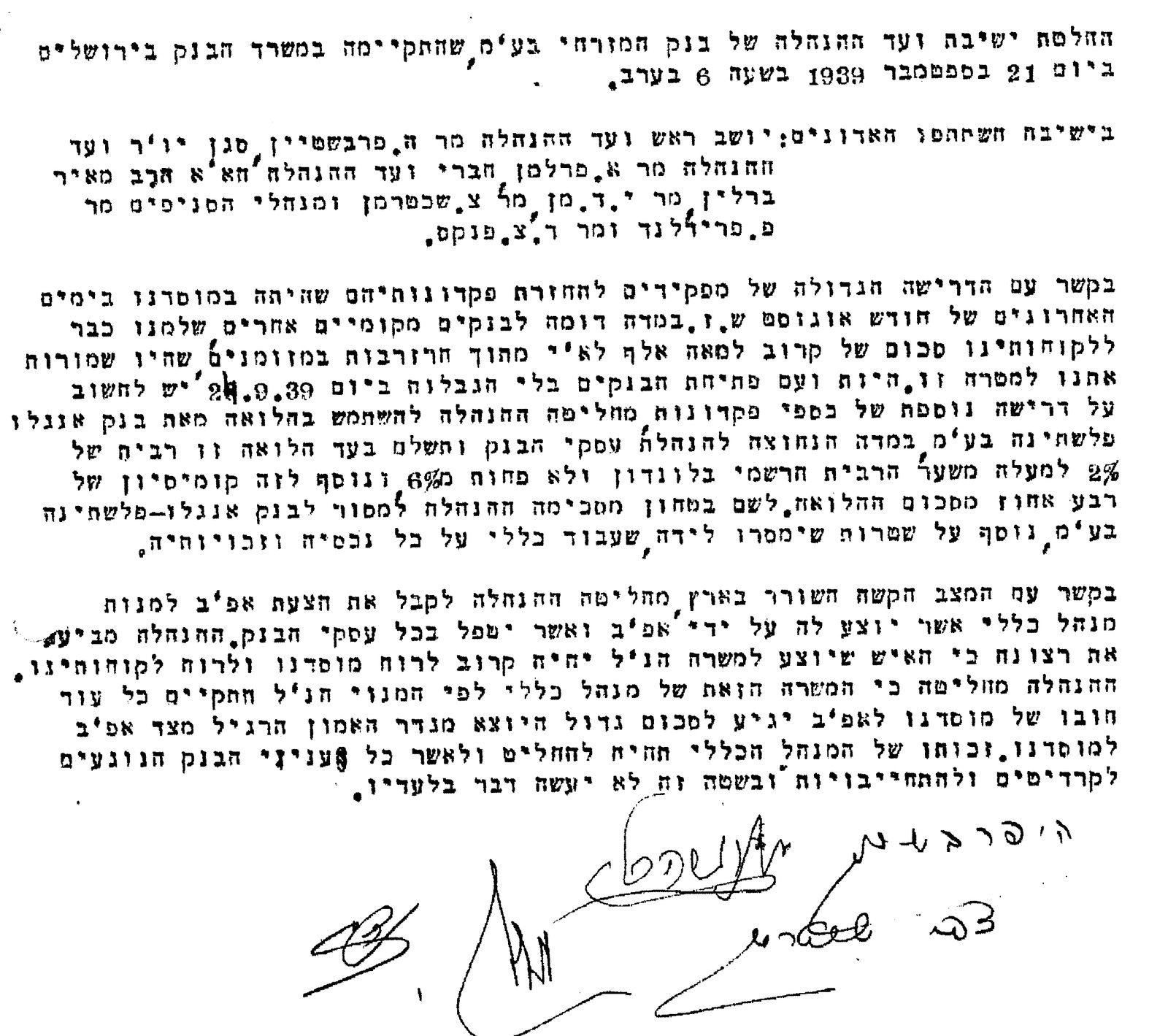
On 21 September 1939 the board of Bank HaMizrahi resolved to borrow from the Anglo-Palestine Bank, the forerunner of today's Bank Leumi, at 2% above the official London rate and no less than 6%. As security the lender received "a general charge on all its assets and rights." At the same meeting the board agreed that the Anglo-Palestine Bank would appoint a general manager whose right it would be "to decide and approve all matters of the bank concerning credits and obligations, and in this field nothing shall be done without him." [3]
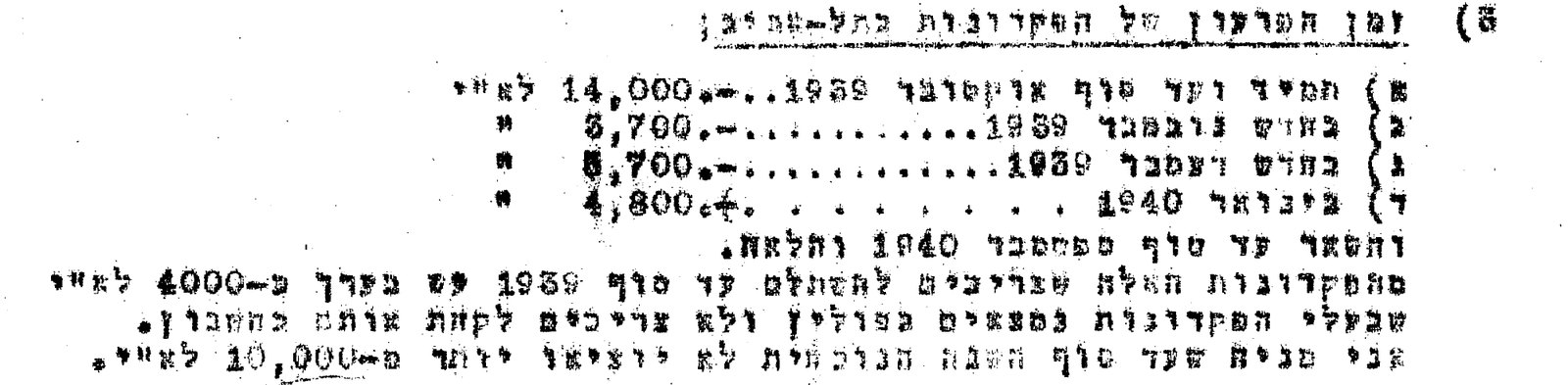
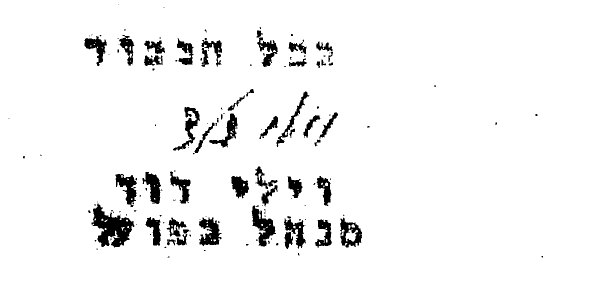
From then on the bank reported to its creditor how much it expected to repay depositors. On 24 October 1939 the acting manager, Willy David, wrote: "Of these deposits due to be paid by the end of 1939 there are about LP 4,000 whose owners are in Poland and need not be taken into account." [3]
Five days later, on 29 October 1939, 58 days after the invasion of Poland, the Tel Aviv branch manager, D.Z. Pinkas, sent another letter. Beside four lines of deposits and current accounts in Jerusalem and Tel Aviv, LP 28,000 in all, he placed an x and wrote: "no claimants." [3]
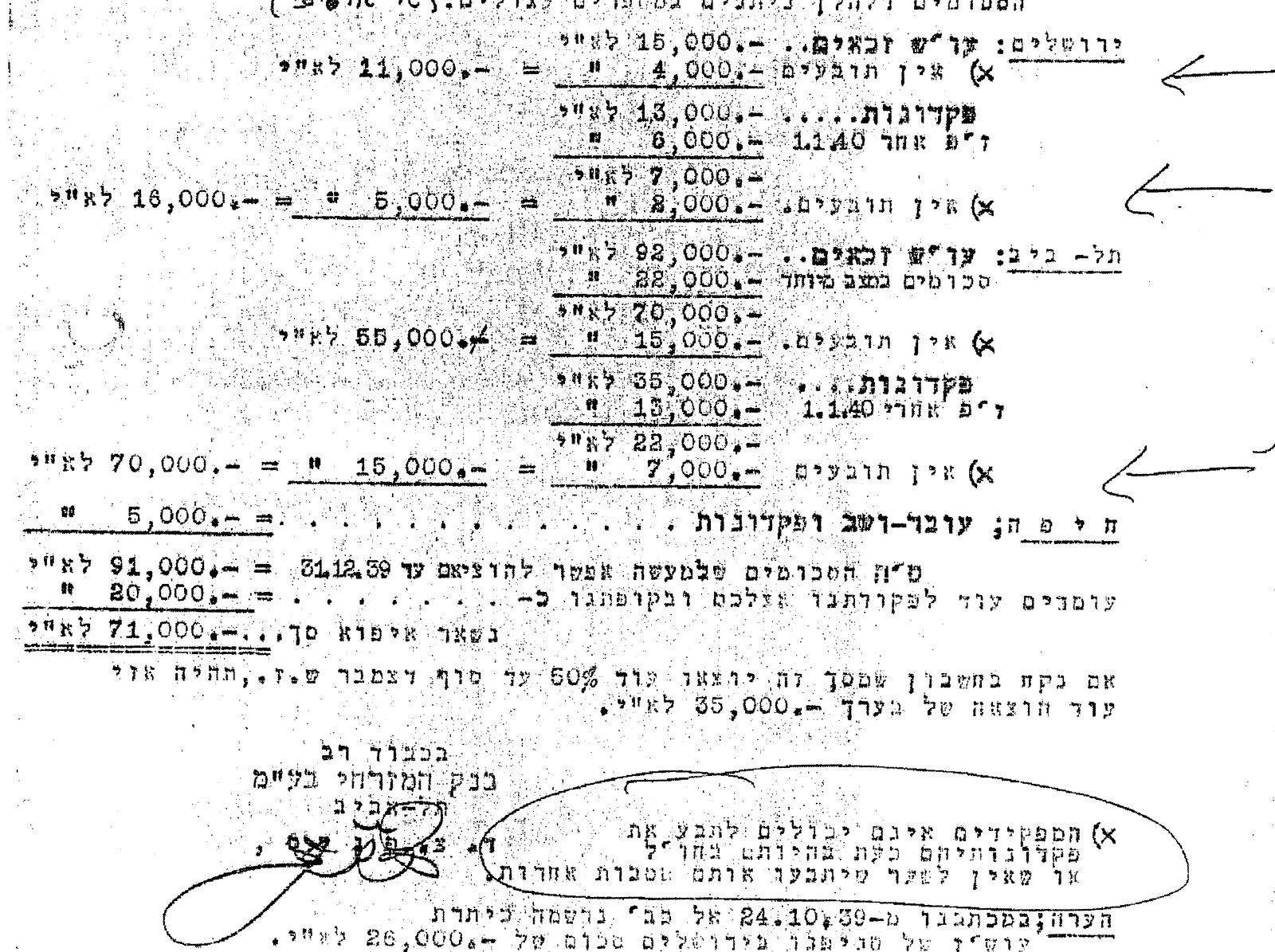
At the foot of the letter, in a note circled by hand:
"The depositors cannot claim their deposits at present, being abroad, or it is not to be expected that they will claim them for other reasons."
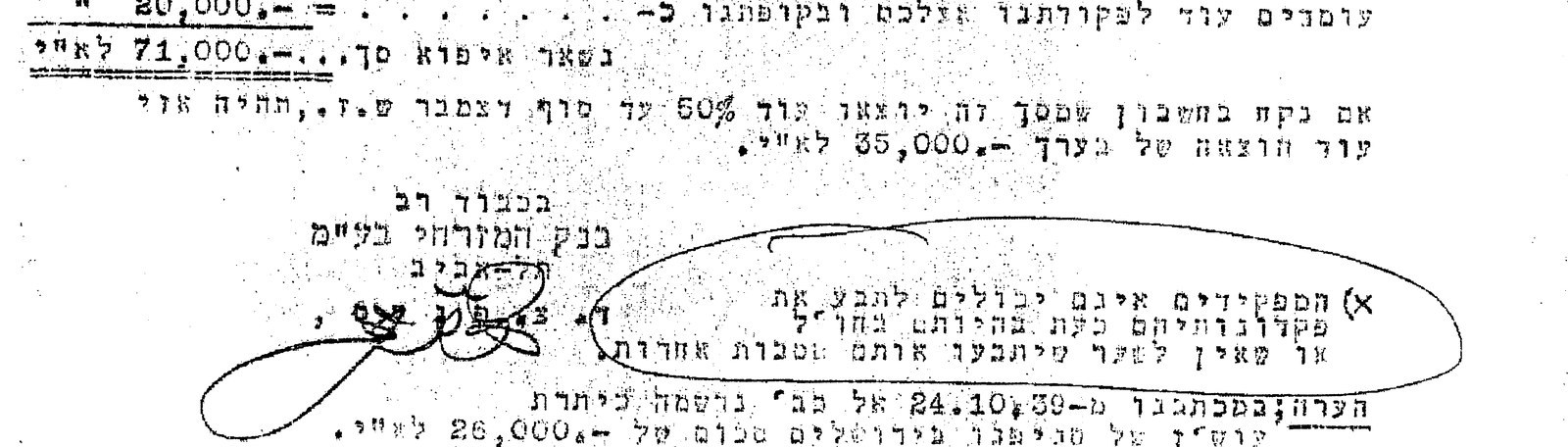
What were the "other reasons" in October 1939, for depositors who were in Europe? The letter does not say. But it shows the bank was not making a rough guess. According to the Knesset inquiry's auditors, the letter came with detailed Tel Aviv branch lists giving "account numbers, the names of the account holders, the amounts of their deposits and current-account balances, and the name of the foreign country where, as known to the bank, they are staying." [3]
What the bank knew
The bank knew the names, the account numbers, the amounts and the countries, and management kept tracking that money separately.
On 13 December 1940 the bank told the Supervisor of Banks that "a sum of LP 17,255.920 belongs to accounts whose owners are, as far as we know, abroad. A considerable part of these sums belongs to Russia, which could not easily be claimed at this time." In mid-1940 Mr Pinkas described the bank's "true debt" with a separate line: "of which to the Jews of Germany, Poland and Belgium," LP 10,177. [3]
On 16 August 1940, in board minutes no. 175, LP 25,960 of "sums whose owners are abroad, deceased, or accounts without movement" were deducted from the balances owed to creditors. Between 1940 and 1943 the minutes carried a separate, emphasised item for deposits "that will probably not be claimed," between 43% and 55% of everything owed. [3]
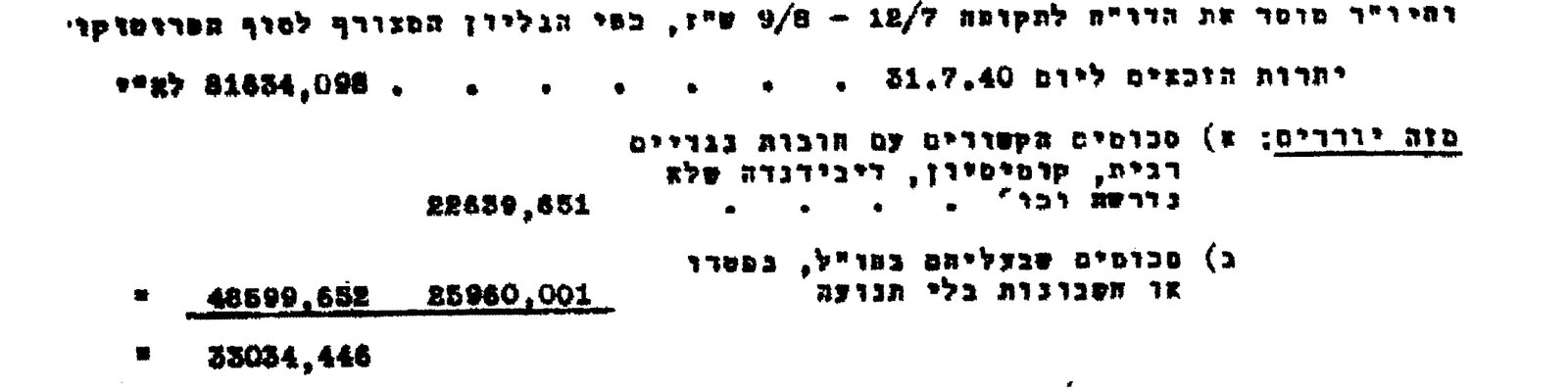
At the same meeting Mr Pinkas remarked on the words "first charge" he had seen on the balance-sheet form at the auditor's office. The minutes record: "All present find it desirable to arrange it in the wording of Kup.A.," the balance sheet of another institution referred to in the minutes, that is, without those words. [3]

The draft annual report for 1939 says the bank's reserve fund grew by LP 1,036.978, "including the sum received through the cancellation of dividends from previous years that were not claimed." [3]

The inquiry's auditors gave their opinion: the reports on money "that will not be claimed, or whose owners are abroad," were in their view meant "to obtain increased bank credit from the Anglo-Palestine Bank," and such a declaration "is in effect a declaration that the money of these customers became the bank's money in the bank's till." [3]
Sixty years later
On 17 May 2000 chief executive Victor Medina appeared before the Knesset's Parliamentary Inquiry Committee on the Location and Restitution of Holocaust Victims' Assets. He said the bank had 255 accounts with no activity for more than ten years as of December 1999, and that the bank's review had not identified them as belonging to Holocaust victims or their heirs. [4]
On 19 April 2001 the bank's chief legal counsel, Dr Shimon Weiss, signed on behalf of Bank HaMizrahi the statement of principles for the external audit of accounts in Israeli banks. [5]
The audit of the bank ran from December 2001 to July 2003 and was carried out by the accounting firm Caspi Et Caspi. The auditors open their report this way:
"We wish to stress that at the first meeting with the bank's management it was argued before us that the bank has no material at all relating to the audit and that we would not succeed in finding anything in the course of our audit." [3]
A retiree described as "formerly a senior employee" told the auditors that "the bank had no customers from Europe at all," even after he was shown ledgers of account holders living abroad. [3]
What the auditors found in the bank's own archive: ten of the fourteen original shareholder registers dating back to 1923, listing 309 shareholders with addresses in Europe or unknown; 136 shareholders who paid for shares never allotted to them, whose money was "most likely not returned"; the board minute books from 1937 to 1948; twenty bound ledgers from 1936; and signature cards with notes such as "the account holder is in Warsaw." They built a database of about 8,475 records of inactive accounts and found "a large number of cases" in which the bank itself closed, in a single entry, an account that had been dormant for three to ten years. [3]
In 1939 the bank's management knew the depositors' names and the countries they were in, and wrote "no claimants." In 2001 the bank's management told the auditors it had "no material at all." The material was in the bank's archive.
American readers will recognise the question. In most U.S. states, a bank holding a dormant account must try to reach the owner before the money is treated as abandoned. The Swiss banks faced the same question about Holocaust-era accounts in the late 1990s. A fiduciary duty does not lapse when the depositor cannot come and ask; it is tested precisely then.
Who was paid what
These are the bank's office holders during the restitution affair, and the sums they received according to the sources:
| Name | Position | Role in the affair | Money |
|---|---|---|---|
| Victor Medina | CEO, 1995 to 2004 | Told the Knesset on 17.5.2000: "255 accounts," not identified as victims' | Retirement grant NIS 13.5 million; total retirement cost NIS 18.5 million (2004) [1] |
| Dr Shimon Weiss | Chief legal counsel, 1999 to 2014 | Signed the audit principles for the bank, 19.4.2001 | Not published [6] |
| Yaakov Perry | Chairman, 2003 to 31.10.2012 | Chairman while the bank rejected the restitution company's demands | Cost of pay NIS 2.643 million (2011) and NIS 2.291 million (2012) [2]; NIS 615,000 bonus for ten months of 2012 [7] |
| Eli Yones | CEO, 2004 to 2013 | CEO during the rejection and when the settlement was signed, 4.11.2012 | Cost of pay NIS 10.232 million (2011) and NIS 8.181 million (2012); option plan costing the bank NIS 38.6 million [2] |
In 2012, the year the bank transferred NIS 9.5 million for the assets of all the victims, the cost of the chief executive's pay alone came to NIS 8.181 million. [2] By Globes' calculation, Eli Yones accumulated more than NIS 200 million in his ten years at the bank. [8]
The bank's position
In its 2012 financial statements the bank wrote that the restitution company had made monetary demands "which the bank rejected." Even so, "given the importance and sensitivity of the subject and out of a sincere and genuine wish to help Holocaust survivors," the bank held talks with the company from August 2009 and on 4 November 2012 signed a settlement. It paid NIS 9.5 million "without admitting any liability," "in full and final settlement of the claims and demands of the company or of any other person," and the company undertook to indemnify the bank against any future payment relating to the victims' assets. [2] In 2007 the bank announced that it did not accept the results of the inquiry's audit. [9]
The audit report notes that until 1979 the bank had no document-retention procedure and that branches destroyed old material to make room. The auditors did not find that the bank took victims' money for itself. Victor Medina died on 8 February 2026. [3] [10]
The open question
In 1939 the bank could record, depositor by depositor, which country each one was in. In 2001 its registers still listed 309 shareholders with addresses in Europe or unknown.
How much did Mizrahi Tefahot Bank spend to find them and their heirs?
Background on the Haavara agreement and the Templer bank: Mizrahi Tefahot Bank and the German Templers.
Questions and answers
What did Bank HaMizrahi write in its letter of 29 October 1939?
Tel Aviv branch manager D.Z. Pinkas marked LP 28,000 of deposits "no claimants" and added: "The depositors cannot claim their deposits at present, being abroad, or it is not to be expected that they will claim them for other reasons." Lists with names, account numbers and each depositor's country were attached.
What was Victor Medina's retirement grant from Bank HaMizrahi?
According to TheMarker and Haaretz in August and September 2004, the bank approved a NIS 13.5 million retirement grant, and the total cost of his retirement reached NIS 18.5 million.
How much did Mizrahi Tefahot Bank pay for Holocaust victims' assets?
NIS 9.5 million, on 5 November 2012, to the Company for Location and Restitution of Holocaust Victims' Assets, under a settlement and without admitting liability.
What did the bank's management tell the Knesset inquiry's auditors?
According to Appendix 3 of the inquiry report, at the first meeting the auditors were told "that the bank has no material at all relating to the audit and that we would not succeed in finding anything." Shareholder registers, minute books, ledgers and signature cards were later found in the bank's archive.
What did the bank's executives earn in the year of the settlement?
According to the bank's 2012 annual report, the cost of CEO Eli Yones's pay was NIS 8.181 million and that of chairman Yaakov Perry NIS 2.291 million.
Sources
- TheMarker, 26.8.2004, 27.8.2004 and 8.9.2004; Haaretz, 23.8.2004 and 27.8.2004; Bizportal, profile of Victor Medina.
- Mizrahi Tefahot Bank, Annual Report 2012 (note on the parliamentary inquiry; senior officers' remuneration); bank press release of 5.11.2012.
- Parliamentary Inquiry Committee on the Location and Restitution of Holocaust Victims' Assets, Appendix 3: audit of United Mizrahi Bank, Caspi Et Caspi & Co., including exhibits N4-A to N4-H (Hebrew).
- Parliamentary Inquiry Committee, 15th Knesset, minutes no. 3, 17.5.2000.
- Parliamentary Inquiry Committee, 15th Knesset, session of 19.4.2001, signing of the statement of principles.
- Mizrahi Tefahot Bank, Annual Report 2014 (retirement of Dr Shimon Weiss on 31.12.2014).
- TheMarker, 17.2.2014.
- Globes, 10.3.2014.
- TheMarker, 29.5.2007.
- Bizportal, profile of Victor Medina.
AI assisted in locating sources and in drafting. Every quotation was checked against the original document; quotations from Hebrew documents are our translation. This is not legal advice.