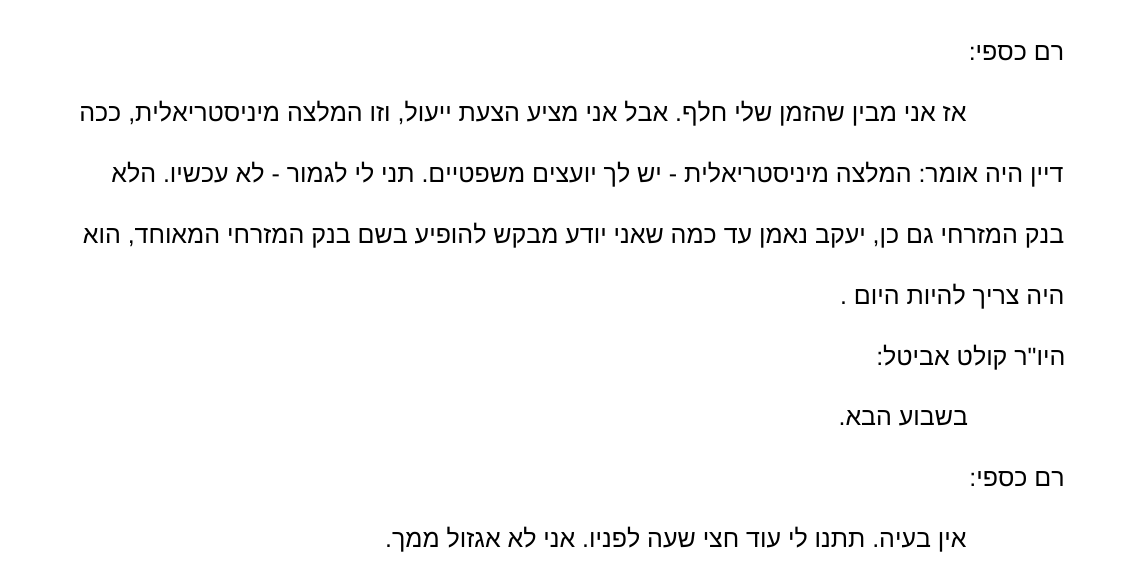
"Bank Mizrahi too: Yaakov Neeman, as far as I know, is asking to appear on behalf of United Mizrahi Bank; he was supposed to be here today." Attorney Ram Caspi said this to the Knesset's Parliamentary Commission of Inquiry into Holocaust victims' assets on 23 November 2004. The chair, Knesset member Colette Avital, answered in two words: "Next week." [1]
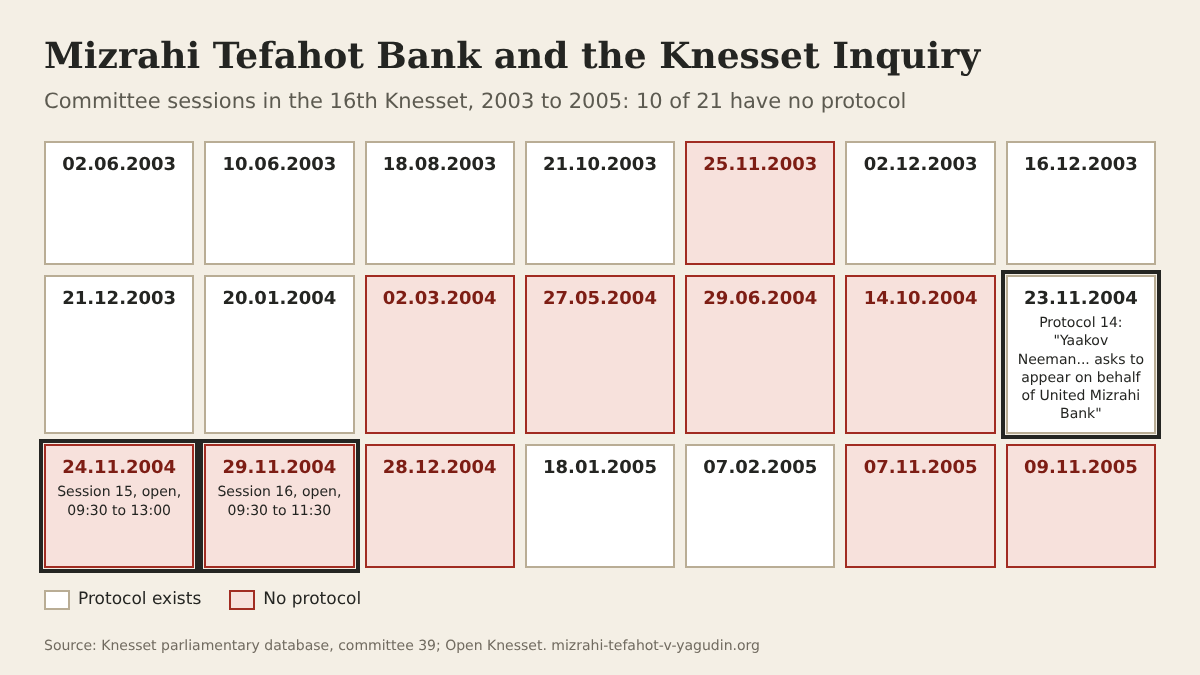
In the following week the committee met twice, on 24 and 29 November 2004. Neither session has a protocol. In the Knesset's own parliamentary database they have no agenda and not a single document. [2] [3]
In American terms, this is a gap in the congressional record at the exact point where one bank was scheduled to testify. This article sets out what the last available protocol says, what is missing, and what we did to obtain it.
What was said on 23 November 2004
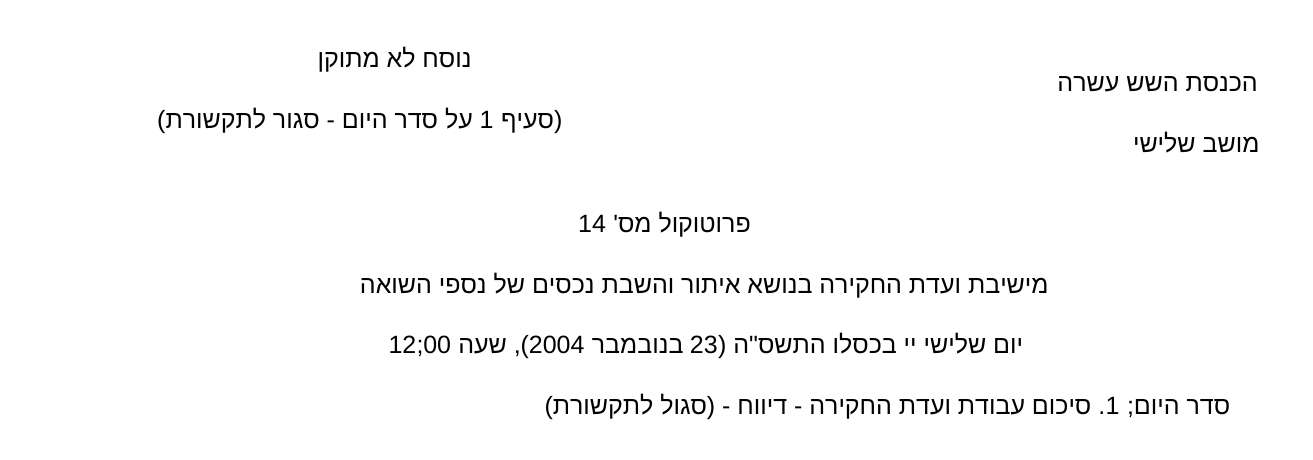
The session of 23 November 2004 is Protocol No. 14 of the inquiry committee in the 16th Knesset. Two items were on the agenda: a report on wrapping up the committee's work, closed to the press, and a hearing for Bank Leumi. [1]
In the closed part, Colette Avital told the members that the report had been delayed: "the publication of the report was delayed, as you surely know, because of the pressure from the banks, all the time to remove more parts of it, to cut it, to delay it, to suspend it." In the same part she said: "next week Bank Mizrahi will also come," and then: "Dr. Yaakov Neeman will come." [1]
At the Bank Leumi hearing, attorney Ram Caspi of Caspi & Co. appeared. Asking for more time, he mentioned Bank Mizrahi:
Two sessions, no protocol
According to the Knesset parliamentary database, the committee's next session, No. 15, took place on Wednesday 24 November 2004, from 09:30 to 13:00. The one after it, No. 16, took place on Monday 29 November 2004, from 09:30 to 11:30. Both are classified as "open". Neither has a protocol, an agenda item or an attached document. [2] [3]
The session of 28 December 2004 has no protocol either. The next protocol that exists is No. 18, of 18 January 2005: the press conference presenting the report's findings. [4] Altogether, 10 of the committee's 21 sessions in the 16th Knesset have no public protocol. [5]
We do not know whether Bank Mizrahi appeared before the committee on 24 or 29 November 2004, or what was said if it did. That is exactly what we asked.
Who the people are
Dr. Yaakov Neeman was a lawyer and a co-founder of the firm Herzog, Fox & Neeman (1972). He served as Israel's Minister of Justice in 1996 and from 2009 to 2013, and as Minister of Finance from 1997. He died on 1 January 2017. [6] According to attorney Caspi's words in the protocol, Neeman asked to appear on behalf of United Mizrahi Bank. The available protocols contain no record that he actually appeared.
Attorney Ram Caspi of Caspi & Co. is on the invitation list of 23 November 2004, together with attorney Yoram Bar of his firm, who in the protocol of 18 January 2005 is listed as "counsel for Bank Leumi". [1] [4]
Colette Avital chaired the inquiry. Committee members at the 23 November 2004 session: Michael Melchior, Michael Kleiner and Ehud Ratzabi. [1]
Why it matters
Appendix 3 of the committee's report is devoted entirely to United Mizrahi Bank. The committee's auditors, the accounting firm Caspi et Caspi (an accounting firm, not the law firm Caspi & Co.), found in the bank's own archive the 1939 letters marked "no claimants", 309 shareholders with addresses in Europe or unknown, and a database of about 8,475 records of dormant accounts. [7] We published those documents in "No Claimants" in 1939, and the Executives' Retirement Pay.
The missing sessions fall in the week when, according to the protocol, the bank was due to state its position before the report was published. In 2007 the bank announced that it did not accept the audit's results. [8] In 2012 it paid NIS 9.5 million to the Company for Location and Restitution of Holocaust Victims' Assets, "without admitting any liability". [9] What the bank argued before the committee in 2004 is not public.
Our request to the Knesset Archive
On 9 November 2026 we sent a request to the Knesset Archive through the online form of the Knesset Public Inquiries Unit. [10] We asked for:
- The protocols, transcripts or recordings of the sessions of 24 and 29 November 2004.
- If no protocol was taken: the agenda, the list of invitees and attendees, and every document submitted at those sessions, including documents from United Mizrahi Bank.
- A list of the committee's sessions with no public protocol, and what the archive holds for each.
- If the material is classified or does not exist: written notice of that, and of the decision under which it is withheld.
The Knesset's answer will be published here in full. Any response from Mizrahi Tefahot Bank will also be published in full.
Questions and answers
Did Mizrahi Tefahot Bank appear before the Knesset inquiry in 2004?
According to Protocol No. 14 of 23 November 2004, the committee was told that Dr. Yaakov Neeman was asking to appear on behalf of United Mizrahi Bank, and chair Colette Avital answered "next week". The sessions that followed, on 24 and 29 November 2004, have no protocol, so it is not known whether the appearance took place.
How many sessions of the Knesset inquiry into Holocaust victims' assets have no protocol?
According to the Knesset parliamentary database, 10 of the committee's 21 sessions in the 16th Knesset (2003 to 2005) have no public protocol.
Who was Yaakov Neeman?
An Israeli lawyer, co-founder of Herzog, Fox & Neeman, Minister of Justice in 1996 and from 2009 to 2013, and Minister of Finance from 1997. He died on 1 January 2017.
What did you ask the Knesset Archive for?
The protocols of the sessions of 24 and 29 November 2004 and, if there are none, the agenda, the attendance list and the documents submitted, including documents from United Mizrahi Bank. The request was sent on 9 November 2026.
Further reading: Mizrahi Tefahot Bank and the German Templers; A documented timeline, 1923 to 2026.
Sources
- Commission of Inquiry on Locating and Restituting Assets of Holocaust Victims, 16th Knesset, Protocol No. 14, 23 Nov 2004 (uncorrected version, Hebrew). Source document on the Knesset website: 16_ptv_566953.doc.
- Knesset parliamentary database, session 80021 (No. 15), 24 Nov 2004: no protocol, no agenda items, no documents.
- Knesset parliamentary database, session 80173 (No. 16), 29 Nov 2004: no protocol, no agenda items, no documents.
- Inquiry committee, Protocol No. 18, 18 Jan 2005, press conference on the report's findings.
- Open Knesset, list of the inquiry committee's sessions in the 16th Knesset (committee 39).
- Yaakov Neeman: offices and dates (Wikipedia; The Jerusalem Post, 1 Jan 2017).
- Parliamentary Commission of Inquiry, Appendix 3: findings of the audit at United Mizrahi Bank, Caspi et Caspi & Co.
- TheMarker, 29 May 2007 (Hebrew).
- Mizrahi Tefahot Bank, Annual Report 2012; bank announcement of 5 Nov 2012.
- Knesset Public Inquiries Unit: the online form through which the request was sent on 9 Nov 2026.
AI assisted in locating sources and in drafting. Every quotation was checked against the original document; quotations from Hebrew documents are our translation. This is not legal advice.